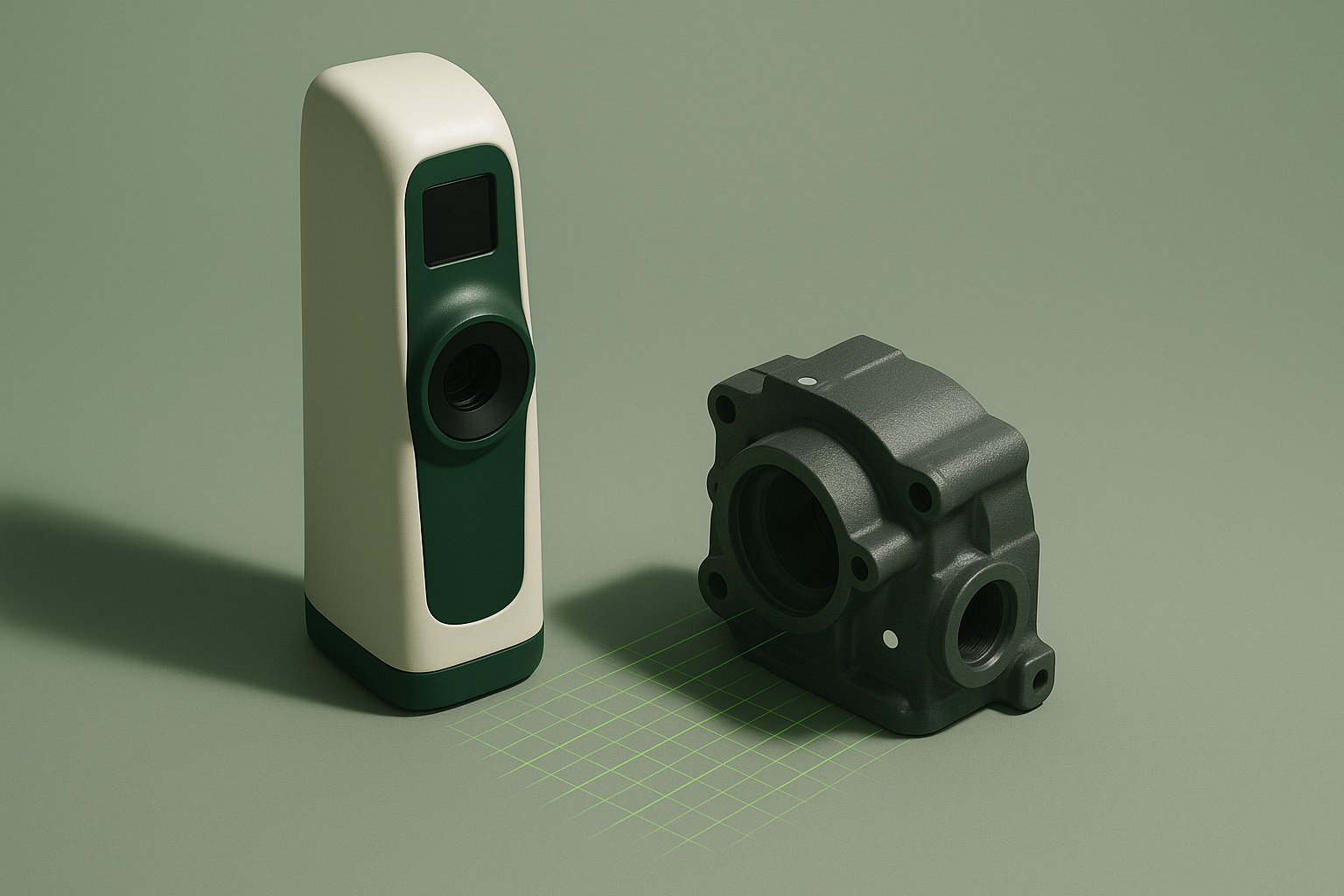
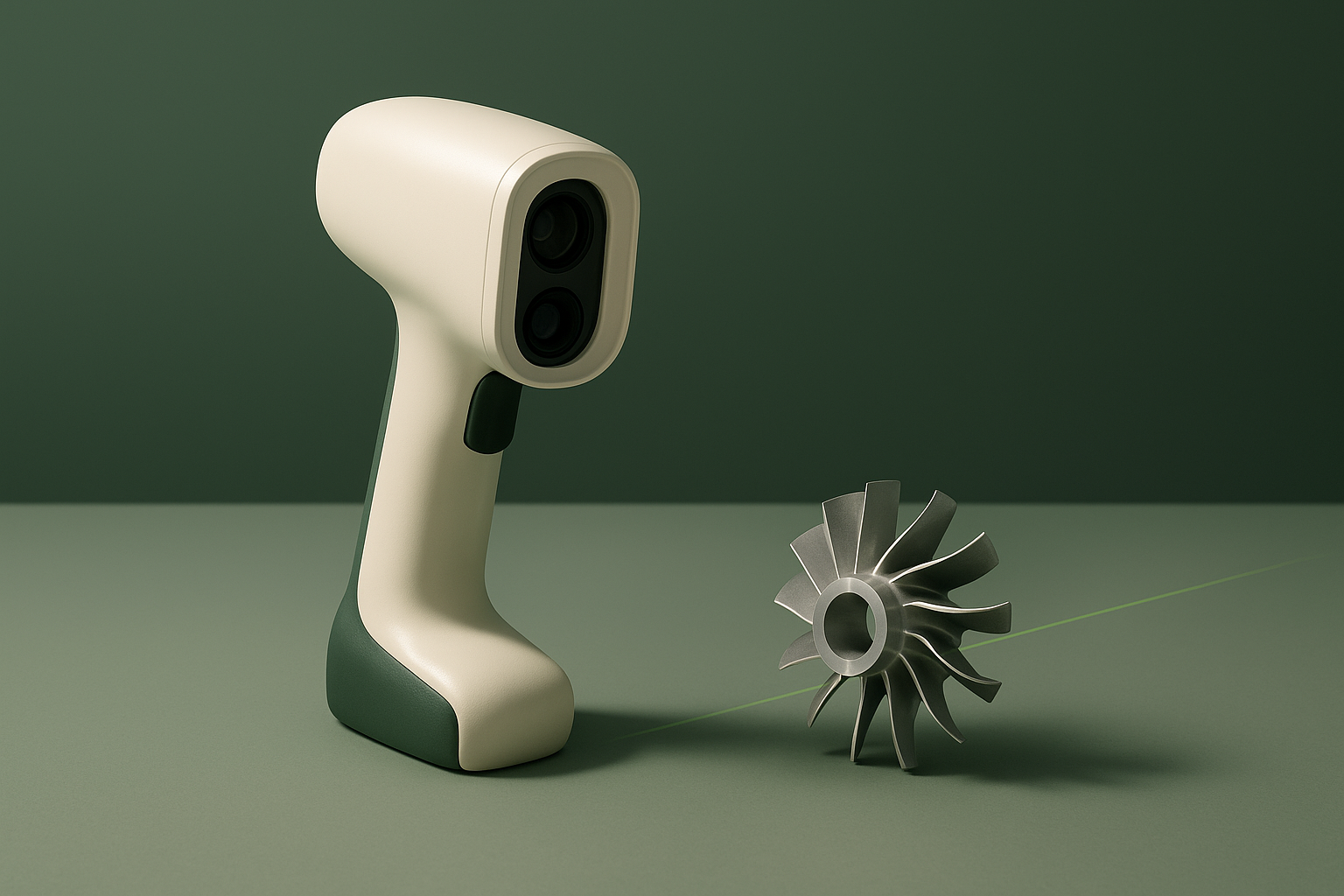
The Revopoint MIRACO Plus is a standalone, touchscreen-equipped 3D scanner built on Revopoint’s Red Dot Award-winning MIRACO platform, now paired with a bundled Photogrammetric Metrology Kit (PMK) for measuring large objects. This review is built entirely from Revopoint’s own product page, launch materials, and published user manual. In brief: the documentation describes a capable, laptop-free scanner for professionals who need both handheld object capture and large-object metrology in one device, at a price and procedural complexity that put it well past casual or hobbyist use.
Fit
Revopoint’s own launch material frames the MIRACO Plus and its metrology kit as a system for “small businesses and tech prosumers,” aimed at safety inspections, maintenance and repair, industrial manufacturing, quality inspection, and industrial design. The specification sheet backs that framing: an onboard Android interface lets it scan without a connected computer, the working distance and scan volume span from 10 x 10 x 10 mm objects up to a 4 x 4 x 4 m capture range, and the included PMK is explicitly built for “large ones like automobiles, ship or aircraft parts, and machinery,” per Revopoint’s own FAQ.
That range makes it a plausible fit for reverse-engineering shops, quality-control teams, and industrial designers who need a single device to walk between a small mechanical part and a car body panel. It is a weaker fit for anyone chasing the finest possible surface detail on small objects: Revopoint’s own FAQ directly states that its MINI2 scanner captures finer detail than the MIRACO Plus, since the MINI2’s fused point distance goes down to 0.02 mm against the MIRACO Plus’s 0.05 mm. It is also not positioned as an entry-level or casual-hobbyist tool — the regular price sits at $2,199 (listed at a $1,869 sale price at the time of writing), well above Revopoint’s smaller handheld models, and the photogrammetry workflow documented in the manual requires targets, scale bars, and a controlled indoor setup rather than a point-and-shoot experience.
Technology & Specifications
Revopoint’s spec sheet describes the MIRACO Plus’s core technology as “Quad-camera Infrared Structured Light with Optical Zoom, and Ultra-resolution Photogrammetric Metrology.” In practice that means two separate capture systems bundled into one handheld unit. The structured-light side uses near- and far-mode infrared camera pairs — a wide 40 x 30° field of view up close and a 56 x 42° field of view at range — combined with a Class 1 (eye-safe) infrared projector, 8 infrared fill LEDs, and 2 white flash LEDs for color capture. A 1.5x and 2x infrared optical zoom is new to the Plus variant and is described as sharpening fine surface detail. The second system, the Photogrammetric Metrology Kit, uses the scanner’s 48-megapixel RGB camera together with coded targets, magnetic or sticky markers, and carbon-fiber scale bars placed around an object; the onboard processor then calculates global coordinates from a series of photographs before point-cloud data is captured against those coordinates.
Per Revopoint’s own FAQ, the Plus variant is stated to be roughly 20% more accurate (single-frame accuracy improved to 0.04 mm) and about 33% faster (up to 20 fps) than the existing MIRACO Pro, with the metrology kit and optical zoom cited as the two features that most distinguish it from the non-Plus MIRACO lineup.
| Specification | Stated value | Source |
|---|---|---|
| Scanning technology | Quad-camera infrared structured light with 1.5x/2x optical zoom, plus photogrammetric metrology | Product page |
| Single-frame accuracy | Up to 0.04 mm | Product page; User manual |
| Single-frame precision | Up to 0.02 mm | Product page; User manual |
| Photogrammetric length accuracy | 0.02 mm + 0.05 mm x L (m), where L is the maximum measured distance in meters | Product page; User manual |
| Fused point distance | Up to 0.05 mm | Product page; User manual |
| Scanning speed | Up to 20 fps | Product page; Press release |
| Working distance | 100 – 1000 mm | Product page; User manual |
| Scan volume (min/max) | 10 x 10 x 10 mm to 4 x 4 x 4 m | Product page; User manual |
| Depth camera resolution | Up to 2 megapixels | User manual |
| RGB camera resolution | 48 megapixels | Product page; User manual |
| Touchscreen display | 6-inch built-in touchscreen, native Android system | User manual |
| Onboard processor | 8-core ARM A76, 2.4 GHz, Mali G52 GPU | Product page; User manual |
| Memory / storage | 32 GB RAM, 256 GB internal storage | Product page; User manual |
| Battery | Internal 5000 mAh, DC 7-11V/5A input, 65W fast charging support | Product page; User manual |
| Weight / dimensions | 750 g; 200 x 50 x 110 mm | Product page; User manual |
| Connectivity | USB Type-C, Wi-Fi 6, Bluetooth 4.1 | Product page; User manual |
| Output file formats | PLY, OBJ, STL, ASC, 3MF, GLTF, FBX | Product page; User manual |
| Price (at time of writing) | $1,869 sale price / $2,199 regular price | Product page |
Limitations
Several constraints are documented directly by Revopoint rather than inferred. The working distance is fixed at 100-1000 mm and the smallest single capture frame is only 28 x 53 mm at the nearest range, meaning very small or highly detailed parts still require many stitched frames rather than a single close-in shot. The fused point distance tops out at 0.05 mm, which Revopoint’s own FAQ contrasts against the finer 0.02 mm figure of its smaller MINI2 scanner — an explicit manufacturer admission that the MIRACO Plus is not the sharpest tool in its own catalog for small-object fine detail.
The photogrammetry workflow carries its own published caveats. The user manual states shooting should only happen indoors under even, soft lighting, that the object or scene must stay rigid and undisturbed throughout the process, that at least 30 photos are recommended (more for larger or more complex scenes), and that at least 8 coded targets must remain visible in every frame. Magnetic coded targets are described as suited only to steel, iron, and stainless-steel surfaces, with sticky targets recommended for non-magnetic materials, and Revopoint’s support FAQ notes that reflective, transparent, or dark surfaces still require scanning spray or a similar powder coating regardless of which capture mode is used.
Weather and environmental resistance are limited: the FAQ describes an IP45 rating (splash-resistant) and states the device “won’t work well in direct sunlight” outdoors, while the manual separately advises keeping the unit away from liquids entirely and lists an operating temperature range of 0-40°C. On the computing side, advanced editing still depends on a PC running Revo Scan 5, and the published minimum requirements are non-trivial — a 12th-generation Intel Core i7 or better with 16 GB RAM on Windows, or Apple M1 Pro or better with 8 GB RAM on macOS. The manual’s recommended Windows specification, by contrast, calls for an 11th-generation Intel Core i9 with at least 32 GB of RAM; Revopoint’s published table does not explain the relative performance of the two chip lines, so no ranking should be inferred from generation number alone. The manual does not publish a screen brightness or resolution figure beyond the 6-inch touchscreen size, and no drop-rating or dust-ingress figure beyond the general IP45 splash claim is stated anywhere in the sourced material.
Software & Workflow
The MIRACO Plus runs Android natively on its onboard 6-inch touchscreen, and Revopoint’s manual describes a full scanning-to-editing pipeline available without a PC: selecting handheld or desktop (turntable) capture, adjusting depth-camera and RGB exposure, switching between near and far modes mid-scan, and running either automated “One-tap Edit” or manual Fusion, Mesh, and Texture steps to finish a model on the device itself. A separate Revo Scan 5 desktop application is described as the companion for more advanced work — detail repair and optimization, multi-format import/export, and full-screen editing — and is required to process and export photogrammetric metrology results using the PMK’s global marker data, with a minimum version of 5.4.12 specified for that function.
For photogrammetry specifically, the manual lays out a four-stage workflow that matches the marketing copy: place scale bars, coded targets, and markers on or around the object; shoot photographs of the object from multiple heights and angles; calculate marker positions and capture point-cloud data on the device; then transfer the project to a PC for processing and export. Models can move off the scanner via Wi-Fi (device and PC on the same network, verified with a PIN or QR code), a USB Type-C cable, or an external USB drive, and the scanner also supports mirroring its screen to a monitor, TV, or PC over a wired DisplayPort-over-USB-C connection or wireless casting.
Supported operating systems for the PC companion software are Windows 10/11 (64-bit) and macOS 11.0 or later. Export coverage spans point-cloud formats (PLY, OBJ, ASC), mesh formats (PLY, OBJ, STL, FBX, GLTF, 3MF), and textured formats (PLY, OBJ, FBX, GLTF), and Revopoint states models exported to STL, OBJ, or 3MF are ready for 3D printing directly. At checkout, Revopoint offers the MIRACO Plus on its own or bundled with a one-year Revo Design license, a permanent Geomagic Design X Go license, or a permanent Revo Design Pro license, with software activation codes delivered by email after purchase.
Alternatives
Revopoint’s own support FAQ points buyers toward two of its own models as lower-cost alternatives when the full MIRACO Plus feature set isn’t needed: the RANGE 2 and POP 3 Plus, described by Revopoint as more compact, lighter, and cheaper options that remain solid choices for users who only need to scan one particular object size range rather than span from small parts to full vehicles. For buyers prioritizing fine small-object detail over the MIRACO Plus’s all-in-one range and metrology kit, Revopoint’s own comparison in the same FAQ points to its MINI2 scanner as the sharper option for that narrower use case.
Beyond Revopoint’s own lineup, ScanLedger notes comparable offerings from other structured-light and hybrid-photogrammetry scanner makers such as Shining3D and Creality as points of reference for buyers shopping in the same general price bracket for a standalone or photogrammetry-capable scanning system. This review does not attempt to state specific competing specifications for those products, since doing so accurately would require the same manufacturer-sourced research applied here to the MIRACO Plus.
Conclusion & Sources
Based strictly on Revopoint’s own documentation, the MIRACO Plus reads as a deliberate expansion of the MIRACO platform rather than a ground-up redesign: the same standalone Android hardware and structured-light core carry over, with the Plus version adding optical zoom, a documented accuracy and speed bump over MIRACO Pro, and a bundled Photogrammetric Metrology Kit that extends the system into large-object measurement. The published specifications support a genuinely wide working range, from centimeter-scale parts to four-meter objects, but that range comes with real published constraints — a coarser point distance than Revopoint’s own small-object scanners, splash- rather than water-resistance, an indoor-only photogrammetry workflow with strict target and marker rules, and PC requirements for advanced editing that are demanding enough to matter for a buyer’s budget planning.
- Revopoint, “MIRACO Plus 3D Scanner — Product & Specifications Page,” https://www.revopoint3d.com/products/all-in-one-3d-scanner-miracoplus, checked 2026-09-09.
- Revopoint, “Press Release: Revopoint MIRACO Plus & Photogrammetric Metrology Kit Launches,” https://www.revopoint3d.com/blogs/news/revopoint-miraco-plus-photogrammetric-metrology-kit-launches, checked 2026-09-09.
- Revopoint (Revopedia), “MIRACO Plus 3D Scanner User Manual,” https://revopedia.revopoint3d.com/en/MIRACOseries/Miracoplususermanual, checked 2026-09-09.