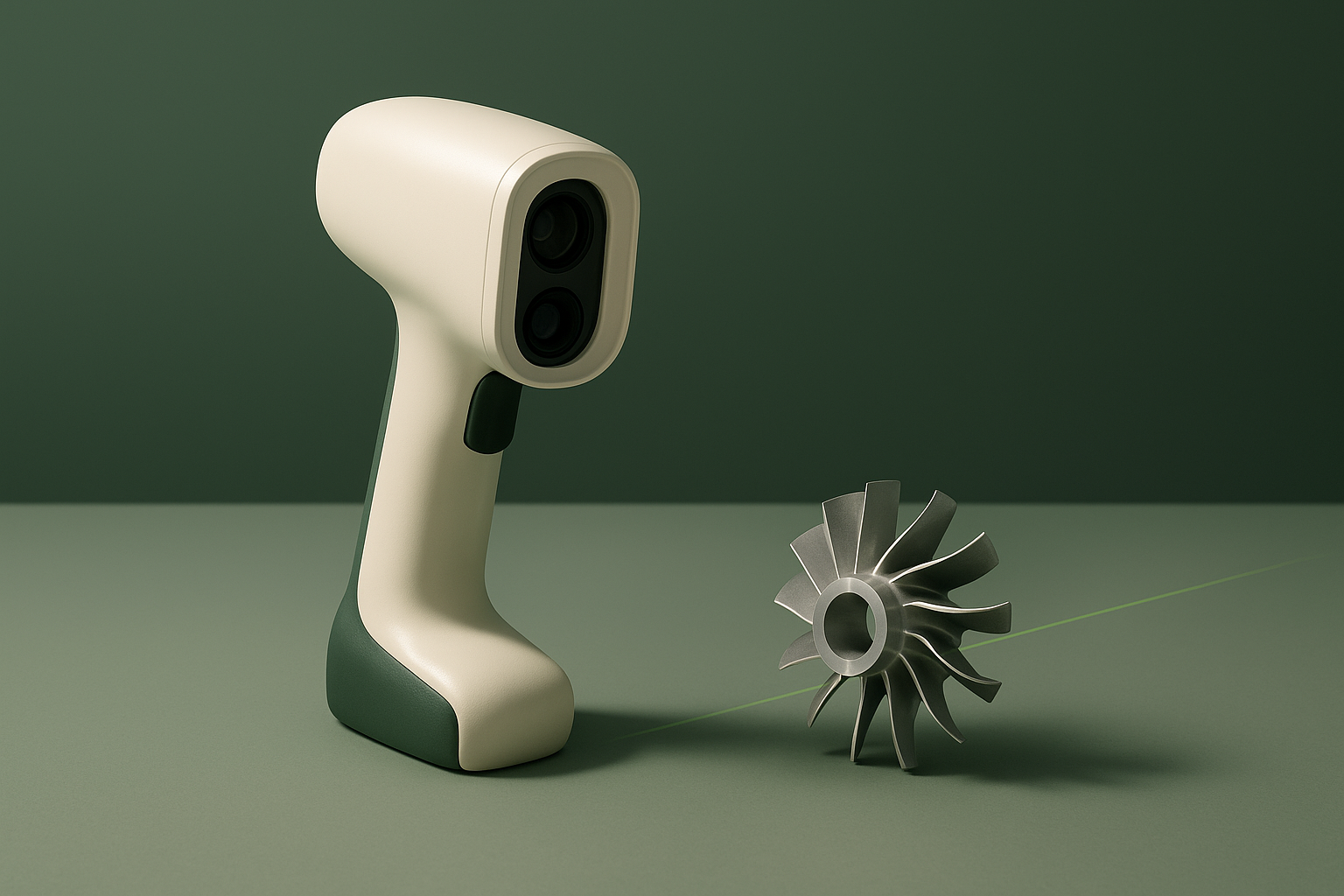
The EINSTAR VEGA is a standalone, battery-powered handheld 3D scanner from EINSTAR, the consumer-facing sub-brand of SHINING 3D. It combines an onboard touchscreen computer with dual structured-light scanning modes, meaning it can capture without being tethered to a laptop. Based on the manufacturer’s own published specifications, it is built for makers, designers, and small studios who want color, full-object capture without assembling a separate PC-and-camera rig, though it is not positioned as a metrology-grade instrument.
Fit
EINSTAR markets the VEGA toward “novice” users, designers, makers, and what it calls “3D printing fanatics,” with an emphasis on artwork, sculptures, and other subjects where color texture capture matters as much as geometry, according to the product listing on the manufacturer’s US store. The all-in-one design — scanner, processor, and 6.4-inch display in a single 535-gram body — removes the laptop-tethering step that other structured-light scanners require, which lines up with a buyer who wants a simple, self-contained capture workflow rather than a full desktop metrology setup.
It is a weaker fit for engineering teams that need certified dimensional accuracy, since EINSTAR’s own specification pages publish point distance and resolution figures but do not list a formal accuracy tolerance (such as a stated +/- mm value) for the VEGA. Buyers whose workflow depends on scanning outdoors in bright light may find the stated support for ambient light up to 100,000 lux useful, but the IP50 rating gives only partial protection against dust ingress — not a fully dust-tight seal — and no water resistance at all, which the manufacturer’s FAQ confirms by stating the VEGA is not waterproof; buyers should not assume the device is suited to wet conditions or to any dusty environment beyond what EINSTAR has actually specified.
Technology & Specifications
The VEGA uses structured-light scanning with two selectable modes. HD Mode relies on an infrared MEMS light source paired with a 2-megapixel IR camera, targeting close-range, high-detail capture at a 100-350mm working distance. Fast Mode switches to an infrared VCSEL emitter with a 1.3-megapixel IR camera, extending the working distance to 270-1500mm for capturing larger objects or full-body scans at a higher frame rate. A separate 48-megapixel RGB camera handles color and texture capture in both modes. Processing runs on an onboard 8-core, 2.4GHz computer with 32GB of RAM and 512GB of SSD storage (plus 32GB eMMC), displayed on a 6.4-inch 2K OLED touchscreen, which is what allows the device to scan without a connected PC.
The table below lists the specification values EINSTAR publishes for the VEGA, each traced to the specific page where it appears.
| Specification | Stated value | Source |
|---|---|---|
| Scanning technology / light source | HD Mode: Infrared MEMS structured light; Fast Mode: Infrared VCSEL structured light | EINSTAR VEGA Specs page |
| Point distance (resolution) | HD Mode: 0.05mm-3mm; Fast Mode: 0.5mm-10mm | EINSTAR VEGA Specs page |
| Working distance | HD Mode: 100-350mm; Fast Mode: 270-1500mm | EINSTAR VEGA Specs page |
| Capture frame rate | HD Mode: up to 15fps; Fast Mode: up to 20fps | EINSTAR VEGA Specs page |
| Color camera | 48MP RGB camera | EINSTAR VEGA product page / Specs page |
| Output/export formats | PLY, STL, OBJ, ASC | EINSTAR VEGA Specs page |
| Onboard computer | 8-core CPU at 2.4GHz, 32GB LPDDR4 RAM, 32GB eMMC + 512GB SSD storage | EINSTAR VEGA Specs page |
| Display | 6.4-inch 2K OLED touchscreen | EINSTAR VEGA Specs page |
| Battery / runtime | Built-in 5000mAh battery, 1.5-2 hours continuous scanning; 65W PD/PPS fast charging; power-bank support | EINSTAR VEGA FAQ / Specs page |
| Connectivity | Wi-Fi 6, USB Type-C | EINSTAR VEGA Specs page |
| Weight / dimensions | 535g (standard edition), 643g (limited edition); 180mm x 95mm x 26.5mm | EINSTAR VEGA Specs page |
| Ingress protection / operating temperature | IP50 (not waterproof); -10C to 40C operating range | EINSTAR VEGA FAQ / Specs page |
| Price | $1,999 USD list price | EINSTAR US Official Store product page |
Limitations
EINSTAR’s published materials leave a few gaps that buyers should weigh before purchasing. Most notably, none of the pages reviewed state a formal accuracy tolerance for the VEGA — the manufacturer publishes point distance and resolution figures (down to 0.05mm in HD Mode) but does not attach an accuracy specification the way some competing devices do. That absence does not necessarily mean the device performs poorly, but it does mean prospective buyers cannot compare VEGA’s dimensional accuracy against other scanners using a manufacturer-stated figure alone.
Battery runtime is another documented constraint: continuous scanning time is listed at 1.5-2 hours per the FAQ page, which is comparatively short for a device intended for longer capture sessions, though it can be extended by connecting an external power bank. The IP50 rating means the VEGA is explicitly not waterproof — under the IEC 60529 ingress-protection standard, the second digit, “0,” indicates no water protection at all — while the first digit, “5,” indicates only partial protection against dust ingress rather than a fully dust-tight (“6”-rated) enclosure; EINSTAR does not publish a claim that the VEGA is rated for any particular dusty environment. In practice, the lack of water resistance limits outdoor use to dry, fair-weather conditions despite the stated tolerance for bright ambient light up to 100,000 lux. The working distance and point-distance ranges are also mode-dependent — a user needs to switch between HD Mode and Fast Mode to move between fine close-range detail and larger-volume, longer-distance capture, rather than getting both simultaneously from a single pass.
EINSTAR’s own FAQ page does not address how the VEGA handles dark, transparent, or reflective materials, a common challenge for structured-light scanners generally. Because the manufacturer’s documentation is silent on this point, this review does not make a claim about VEGA’s performance on those surface types one way or the other.
Software & Workflow
Two software paths are documented for the VEGA. The onboard touchscreen runs the EINSTAR VEGA App, which the manufacturer’s download center describes as allowing scanning and basic operation directly on the device without a connected computer. For fuller post-processing, EINSTAR offers StarVision, a desktop application (version 1.3.6.6 at the time this page was checked) available for both Windows and Mac, downloadable from the support site linked off the VEGA download-center page. StarVision requires Windows 10/11 (64-bit) or macOS 11.0 or later, and EINSTAR recommends an Intel i7 processor with 32GB of RAM for the desktop software — a notably capable spec relative to typical consumer laptops, suggesting heavier processing workloads may benefit from a well-equipped machine even though the scanner itself does not require a PC to capture data.
The specs page also lists alignment modes available during processing: feature, texture, marker, and hybrid alignment, giving users several ways to stitch scan passes together depending on the object’s geometry and surface pattern. The product page additionally mentions a scanning rewind capability and automatic base-plane detection as workflow aids, and a companion SHINING 3D Cloud platform that includes 5GB of free storage for scan data. Exported models come out in PLY, STL, OBJ, or ASC format, covering the common formats used by 3D printing slicers, CAD import tools, and general mesh viewers. Reflective markers (3mm and 6mm sizes) ship in the box for marker-based alignment on featureless or symmetrical objects.
Alternatives
ScanLedger includes three categories of alternative here, each for a specific reason rather than general popularity. Handheld color structured-light scanners from Revopoint’s higher-end lineup are a relevant comparison because they compete on the same portability-and-color-capture axis, though most require a connected computer or mobile device rather than the VEGA’s built-in touchscreen. Creality’s CR-Scan handheld series is included because it targets a comparable maker and 3D-printing budget, with its own tradeoffs around working distance and accuracy that a buyer should check against the manufacturer’s current specifications rather than assume. SHINING 3D’s own EinScan handheld line — sold under the parent company’s main brand rather than the EINSTAR sub-brand — is included because it targets an overlapping audience with different mode and accuracy tradeoffs. None of these alternatives are detailed with specific figures here; anyone shortlisting against the VEGA should pull each manufacturer’s own current spec sheet before deciding.
Conclusion & Sources
The EINSTAR VEGA’s documented strength is its all-in-one form factor: a battery-powered, touchscreen-equipped scanner that captures color and geometry with dual working-distance modes and does not require a tethered computer to operate. Its documented gaps are just as relevant to a purchase decision — no published accuracy tolerance, a 1.5-2 hour battery window, and an IP50 rating that provides no water resistance and only partial dust protection, rather than a rating suited to wet conditions or demanding dusty settings. At a $1,999 list price, it sits in a bracket where buyers should weigh the convenience of a standalone device against scanners that publish more complete accuracy data or offer longer runtime.
- EINSTAR VEGA product page, einstar.com/products/einstar-vega — checked 2026-09-09
- EINSTAR VEGA Specifications page, einstar.com/pages/einstar-vega-specs — checked 2026-09-09
- EINSTAR VEGA FAQ page, einstar.com/pages/einstar-vega-faq — checked 2026-09-09
- EINSTAR VEGA Download Center, einstar.com/pages/download-center-einstar-vega — checked 2026-09-09
- EINSTAR US Official Store, VEGA product page, us.einstar.com/products/einstar-vega — checked 2026-09-09
- IEC 60529 ingress-protection (IP) code reference table, ABB, library.e.abb.com/…/1SXU000023C0202_18.pdf — checked 2026-09-09